
General Questions
Ocean Bay Boats Pre-Trip Safety Checklist
Pre-Trip Safety Checklist – Read the Full Article
- Check the local weather forecast for the area and timeframe of your trip.
- Communicate your trip plan before every outing. Let people know where you plan to go and when you plan to return.
- Always wear a PFD and carry a paddle.
- Equipment Check – all watercraft
- Drain plug is closed
- Hatches are closed and secured
- Seat is secured to watercraft
- Accessories mounted on accessory tracks are secured
- Equipment Check – pedal and powered watercraft
- Propeller is free from debris and prop hardware is secured
- Rudder deployment and steering functions correctly
- All rudder hardware has been inspected and tightened for proper operation
- Equipment Check – powered watercraft
- Battery level is sufficient for trip
- Battery plugs and terminals are free from debris and corrosion
- Battery plugs and outlets are properly greased
- Battery connections are clean and tightened
- Battery is installed properly and secured to watercraft
- Test power or pedal drive functionality on land before taking out on the water
- Items to Carry (and know how to use) *Always check local regulations for watercraft safety requirements in your area.
- Sponge or bilge pump
- Tow line
- Dry bag (with extra water, food, sunscreen, etc.)
- Knife and basic hand tools
- First-aid kit
- Basic parts or repair kit (prop, prop pins, kill switch keys)
- Spare paddle
- Paddle float (or other rescue aid for kayaking)
- Throwable floatation device (for canoeing)
- Rope bag (for canoeing)
- Flares*
- VHF Radio*
- Airhorn/whistle*
- Navigation lighting*
Kayak carts are a great and convenient way to transport your kayak to and from the water’s edge. We strongly discourage the use of landing-gear carts that are drilled into your kayak or scupper-style carts. These carts place undue pressure on your kayak’s hull and may cause irreparable damage to your hull. Damage caused by accessories is not likely to be covered by warranty, as it is not a manufacturer’s defect. We recommend selecting a bunk-style cart, that provides maximum hull support.
Due to potential hull damage and wear points that can be caused to scuppers during use, Ocean Bay Boats does not recommend the use of kayak scupper carts. Ocean Bay Boats recommends the use of cradle-style and other strap-style kayak carts.
HULL EXTERIOR: Wash with mild soap and water. You can also use Murphy’s Oil Soap. To beautify, we suggest a vinyl protectant product such as Armor All®, 303 Products or Pledge. These are safe for use on any of our Polyethylene, Superlinear, Royalex® and Fiberglass canoes or kayaks.
We do not recommend waxing your hull with a paste wax, such as most car waxes. The wax fills in any scratches or gouges, then dries to a white color, making the damage more apparent.
HULL INTERIOR: Wash with mild soap and water. We DO NOT recommend using any of the above products or polishes on the interior, as the floor of your boat may become slippery.
In order to get a duplicate Manufacturer’s Statement of Origin (MSO) you should contact us. If for some reason you cannot reach our authorized dealer (you have moved, or the dealer is no longer in business, etc.), email customer service with your request.
If you need new decals for your Old Town canoe or kayak, first check with your local dealer to see if they carry these items. If not, please email customer service and request the decals you are looking for. Our Old Town canoe decals are available in our online store – click here.
You should choose your canoe paddle based on your height and seat position. In the bow position, you want a paddle that measures from the floor to the middle of your chest. In the stern you need more length to assist in steering, so your paddle should stand up to the height of your collarbone.
For a kayak paddle, consider the boat width, as well as the paddler’s torso length and paddling style. Longer paddles are better suited to taller people, wider kayaks and a more relaxed style of paddling; shorter paddles match up better with shorter people, narrower kayaks and a more vertical style of paddling.
Choosing between a wood or synthetic paddle is a matter of personal preference as well as intended use. Our wood paddles are more aesthetically pleasing, have a nicer feel in the water and of course are more traditional. On the other hand, our synthetic paddles are more durable and will work great as a general utility paddle.
CANOES: Always store upside-down, even overnight. If at all possible, set on sawhorses or blocks, as this will allow the gunwales to carry the weight. Consult our Canoe Storage Guide for model-specific storage techniques.
KAYAKS: Should be stored deck-side down on padded supports about 30% of the kayak’s overall length from the ends. If stored outside we recommend a cockpit cover to prevent the possibility of water getting inside. Read our Kayak Storage Guide for more information.
If you must store your canoe or kayak outside, we recommend you tie it down, as strong winds can catch the underside, flip it, and cause damage. Also, ultraviolet light from the sun may fade the color over time; if possible, store your boat out of the sun. If stored outside, do not cover with a tarp laid directly on the boat, as the heat of the sun will create an oven under the tarp that can damage, distort or discolor the hull. A tarp properly suspended above the boat will protect it from ultraviolet light. Simply leave sufficient space to allow for air circulation.
If your watercraft no longer suits your needs but is in working order, you can likely donate or sell it. In many situations, repairs are possible and relatively straightforward to perform. Contact us at :info@oceanbayboats.com if you have questions about repairs. If your watercraft is no longer functional, please contact your local recycling center to understand how they can accept the high-density polyethylene (HDPE) material. A leaky canoe also makes a great outdoor raised garden bed!
The Total Weight Capacity refers to the total weight a watercraft can carry, including assembled parts, seat, paddler, gear, and any other items that come standard with the watercraft (i.e. A PDL or Motor console for kayaks that come with them).
The Usable Weight Capacity refers to the recommended weight for optimal performance, handling, and safety. It factors in the assembled parts, seat, and drive (when applicable).
Size and fit are very important when it comes to the performance of a life jacket. We always recommend entering a paddle shop where an expert can help you find a proper-fitting life jacket.
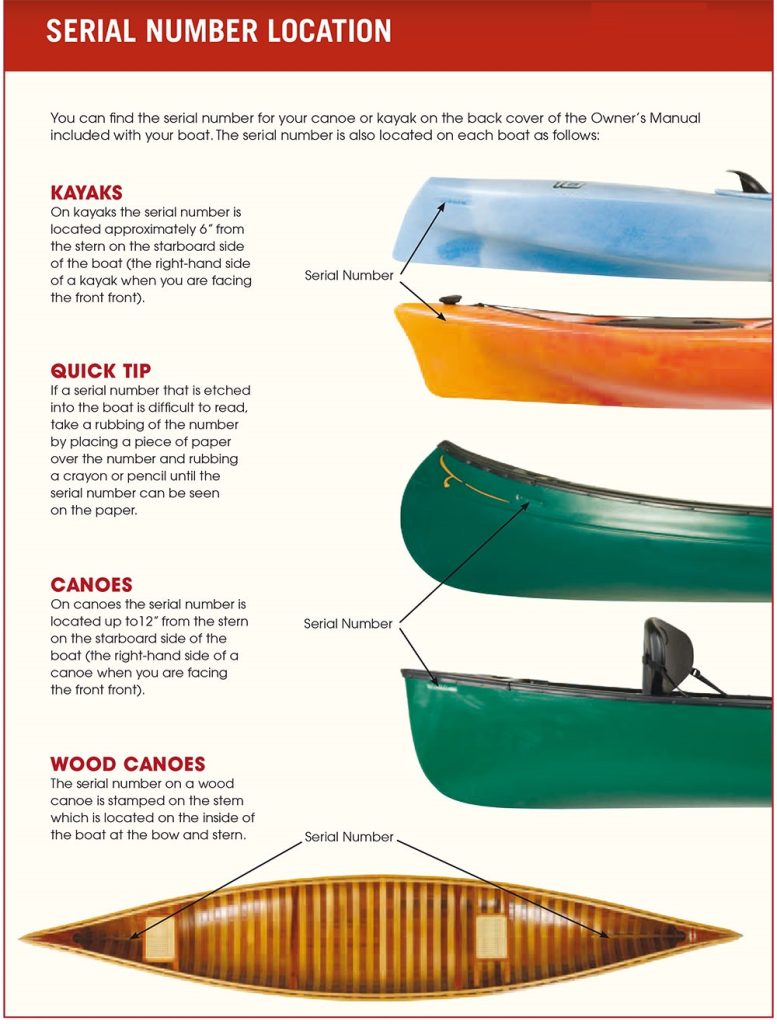
You can find the serial number for your canoe or kayak on the back cover of the Owner’s Manual included with your boat. The serial number is also located on each boat as follows.
- On kayaks the serial number is located approximately 6″ from the stern on the starboard side of the boat (the right-hand side of a boat when you are facing the front front).
- On canoes the serial number is located up to 12″ from the stern on the starboard side of the boat. The serial number on a wood canoe is stamped on the stem which is located on the inside of the boat at the bow and stern.
If a serial number that is etched into the boat is difficult to read, take a rubbing of the number by placing a piece of paper over the number and rubbing a crayon or pencil until the serial number can be seen on the paper.
No, salt water will not damage your canoe or kayak or any of its components with brief exposure. However, if you are using your boat frequently in salt water, it should be rinsed down after every use to avoid discoloration or corrosion of components.