
Canoe Questions
Cane and spline for repairing cane seats are sold online at Island Falls Canoe.
Please consult our Canoe Storage Guide for model-specific storage techniques.
You can use either a motor mount or sidesaddle motor mount.
Factory installed roof racks and reputable aftermarket racks can be padded for scratch prevention. Be aware of roof rack weight ratings, and make sure you have the correct rack for your canoe. Whichever type of carrier you use, be sure to tie 2 belly straps and front and rear guide ropes for stability when transporting your canoe.
The addition of a small amount of black to our solid red and green canoes helps hide scratches and dents, and improves the long-term appearance of the hull.
In storage, Royalex boats sometimes develop mildew on them. Also, Royalex boats have been known to have processing oils migrate up out of the plastic when exposed to repeating cycles of temperature extremes. These oils were in the plastic solely to aid in the original manufacture of the Royalex sheet. Losing them actually makes the Royalex tougher. The following procedure gives good results for both causes of sticky Royalex:
- DO THIS PROCEDURE EITHER OUTDOORS OR IN A VERY WELL VENTILATED AREA.
- Wipe the sticky surface with denatured alcohol. This type of alcohol can usually be bought at a paint supply store, and may be marked as painter’s alcohol, ethyl alcohol or denatured alcohol. DO NOT use rubbing alcohol.
- Use rubber or latex gloves. Saturate a soft cloth with the alcohol and wipe using fairly long even strokes. Turn the cloth often so as not to use the same area over and over. The alcohol will evaporate quickly so you will not have to wipe dry.
- If you still have some sticky areas, just wipe over again.
CAUTION: These alcohols are extremely poisonous if ingested. Please store them in a safe place away from children.
Fishing Boats Questions
Many penetrating stains work well for staining Okoume and are compatible with epoxy. We recommend staining the seats on our Wherry to contrast with hulls. It is always important to test a stain prior to applying it to any of your boat parts. To do this, find a couple scraps of wood. Stain one of them and let the stain dry thoroughly. Next, mix some epoxy and spread it on the surface of the stained wood and clamp your second piece of wood to it. Allow the epoxy to cure fully and pry the two pieces apart. If in this process you tear wood fibers, you can be assured that the stain is compatible.
There are some concerns with staining panels of boats. In order for stain to take to the wood it must be applied to bare wood, prior to epoxy. This means staining before you begin construction of your boat. When a boat is wired together and the seams glued, all of the chines are rounded to help the fiberglass cloth lay flat against the boat. During the sanding of these seams, it is likely you will sand through the stain that was applied to the panels along the seams. The result is lighter stripes running the length of your boat along the seams. Going over these areas with stain and getting a good color match can be difficult. Because of this reality we do not recommend staining hull or deck panels of multi-paneled boats.
John Lockwood designs Pygmies for the rigors of saltwater expeditions and rocky shore landings. As strong as fiberglass, yet 30% lighter, your Pygmy will give you a lifetime of use and adventure. The upkeep is simple:
- Epoxy needs protection from prolonged exposure to ultra-violet rays. After completion, coat your boat with high quality marine spar varnish (with UV inhibitors). We recommend Z-Spar’s “Flagship” or System Three’s Spar Urethane Varnish. Two or three coats do the job. Depending on use, re-varnish in 3 to 7 years.
- Frequently dragging your boat full of camping gear onto rocky shores will cause abrasion along the keel line. (Similarly, fiberglass hulls also wear through their gel coat and into the glass at the sharp ends of the keel line when driven up on beaches.) Our construction manuals direct you to lay a “sacrificial” layer of glass tape OVER the already glassed keel. This protects the hull’s glass job. The tape strip takes all the wear and tear. Every 2 to 5 years, depending on use, flip your boat over, sand the keel and epoxy on a new sacrificial strip
Yes! We do, but it is not necessary to take a class in order to build one of our boats. Nonetheless, our classes have been very popular and fill quickly. You can check-out a schedule here: boat building classes.
Kayaks are a highly personal craft. It needs to fit your frame, intended uses and your aesthetics. These essential factors should influence your decision: your height, weight, and shoe size, the intended uses of your boat, and your family structure (single, couple, kids, dogs…). Start by reviewing our All Boats and Specs and our Boat Reviews pages.
Precision pre-cut BS-1088 Okoume plywood panels (all 4mm)
- Cockpit coamings
- All epoxy and fiberglass cloth for inside and outside of the hull and over the deck
- Fiberglass tape
- Wire
- Squeegee
- Dental syringes
- Latex gloves
- Wood flour
- Calibrated Pumps
- Stirring sticks
- Steel push pins
- Temporary frames
- 2-part seat
- Keeper’s® footbraces
- Illustrated construction manual
Depending on use and where you store your boat, you will need to re-varnish every few years (boats stored inside will not need fresh varnish nearly as often as boats stored outside).
You will need a dry space large enough to comfortably move around your boat. Folks most often use garages and basements. Carports, decks, and porches work well in warm weather. Apartment living rooms covered with drop clothes will do. Just make sure your completed boat will extract out of a window or door.
General Questions
Ocean Bay Boats Pre-Trip Safety Checklist
Pre-Trip Safety Checklist – Read the Full Article
- Check the local weather forecast for the area and timeframe of your trip.
- Communicate your trip plan before every outing. Let people know where you plan to go and when you plan to return.
- Always wear a PFD and carry a paddle.
- Equipment Check – all watercraft
- Drain plug is closed
- Hatches are closed and secured
- Seat is secured to watercraft
- Accessories mounted on accessory tracks are secured
- Equipment Check – pedal and powered watercraft
- Propeller is free from debris and prop hardware is secured
- Rudder deployment and steering functions correctly
- All rudder hardware has been inspected and tightened for proper operation
- Equipment Check – powered watercraft
- Battery level is sufficient for trip
- Battery plugs and terminals are free from debris and corrosion
- Battery plugs and outlets are properly greased
- Battery connections are clean and tightened
- Battery is installed properly and secured to watercraft
- Test power or pedal drive functionality on land before taking out on the water
- Items to Carry (and know how to use) *Always check local regulations for watercraft safety requirements in your area.
- Sponge or bilge pump
- Tow line
- Dry bag (with extra water, food, sunscreen, etc.)
- Knife and basic hand tools
- First-aid kit
- Basic parts or repair kit (prop, prop pins, kill switch keys)
- Spare paddle
- Paddle float (or other rescue aid for kayaking)
- Throwable floatation device (for canoeing)
- Rope bag (for canoeing)
- Flares*
- VHF Radio*
- Airhorn/whistle*
- Navigation lighting*
Kayak carts are a great and convenient way to transport your kayak to and from the water’s edge. We strongly discourage the use of landing-gear carts that are drilled into your kayak or scupper-style carts. These carts place undue pressure on your kayak’s hull and may cause irreparable damage to your hull. Damage caused by accessories is not likely to be covered by warranty, as it is not a manufacturer’s defect. We recommend selecting a bunk-style cart, that provides maximum hull support.
Due to potential hull damage and wear points that can be caused to scuppers during use, Ocean Bay Boats does not recommend the use of kayak scupper carts. Ocean Bay Boats recommends the use of cradle-style and other strap-style kayak carts.
HULL EXTERIOR: Wash with mild soap and water. You can also use Murphy’s Oil Soap. To beautify, we suggest a vinyl protectant product such as Armor All®, 303 Products or Pledge. These are safe for use on any of our Polyethylene, Superlinear, Royalex® and Fiberglass canoes or kayaks.
We do not recommend waxing your hull with a paste wax, such as most car waxes. The wax fills in any scratches or gouges, then dries to a white color, making the damage more apparent.
HULL INTERIOR: Wash with mild soap and water. We DO NOT recommend using any of the above products or polishes on the interior, as the floor of your boat may become slippery.
In order to get a duplicate Manufacturer’s Statement of Origin (MSO) you should contact us. If for some reason you cannot reach our authorized dealer (you have moved, or the dealer is no longer in business, etc.), email customer service with your request.
If you need new decals for your Old Town canoe or kayak, first check with your local dealer to see if they carry these items. If not, please email customer service and request the decals you are looking for. Our Old Town canoe decals are available in our online store – click here.
You should choose your canoe paddle based on your height and seat position. In the bow position, you want a paddle that measures from the floor to the middle of your chest. In the stern you need more length to assist in steering, so your paddle should stand up to the height of your collarbone.
For a kayak paddle, consider the boat width, as well as the paddler’s torso length and paddling style. Longer paddles are better suited to taller people, wider kayaks and a more relaxed style of paddling; shorter paddles match up better with shorter people, narrower kayaks and a more vertical style of paddling.
Choosing between a wood or synthetic paddle is a matter of personal preference as well as intended use. Our wood paddles are more aesthetically pleasing, have a nicer feel in the water and of course are more traditional. On the other hand, our synthetic paddles are more durable and will work great as a general utility paddle.
CANOES: Always store upside-down, even overnight. If at all possible, set on sawhorses or blocks, as this will allow the gunwales to carry the weight. Consult our Canoe Storage Guide for model-specific storage techniques.
KAYAKS: Should be stored deck-side down on padded supports about 30% of the kayak’s overall length from the ends. If stored outside we recommend a cockpit cover to prevent the possibility of water getting inside. Read our Kayak Storage Guide for more information.
If you must store your canoe or kayak outside, we recommend you tie it down, as strong winds can catch the underside, flip it, and cause damage. Also, ultraviolet light from the sun may fade the color over time; if possible, store your boat out of the sun. If stored outside, do not cover with a tarp laid directly on the boat, as the heat of the sun will create an oven under the tarp that can damage, distort or discolor the hull. A tarp properly suspended above the boat will protect it from ultraviolet light. Simply leave sufficient space to allow for air circulation.
If your watercraft no longer suits your needs but is in working order, you can likely donate or sell it. In many situations, repairs are possible and relatively straightforward to perform. Contact us at :info@oceanbayboats.com if you have questions about repairs. If your watercraft is no longer functional, please contact your local recycling center to understand how they can accept the high-density polyethylene (HDPE) material. A leaky canoe also makes a great outdoor raised garden bed!
The Total Weight Capacity refers to the total weight a watercraft can carry, including assembled parts, seat, paddler, gear, and any other items that come standard with the watercraft (i.e. A PDL or Motor console for kayaks that come with them).
The Usable Weight Capacity refers to the recommended weight for optimal performance, handling, and safety. It factors in the assembled parts, seat, and drive (when applicable).
Size and fit are very important when it comes to the performance of a life jacket. We always recommend entering a paddle shop where an expert can help you find a proper-fitting life jacket.
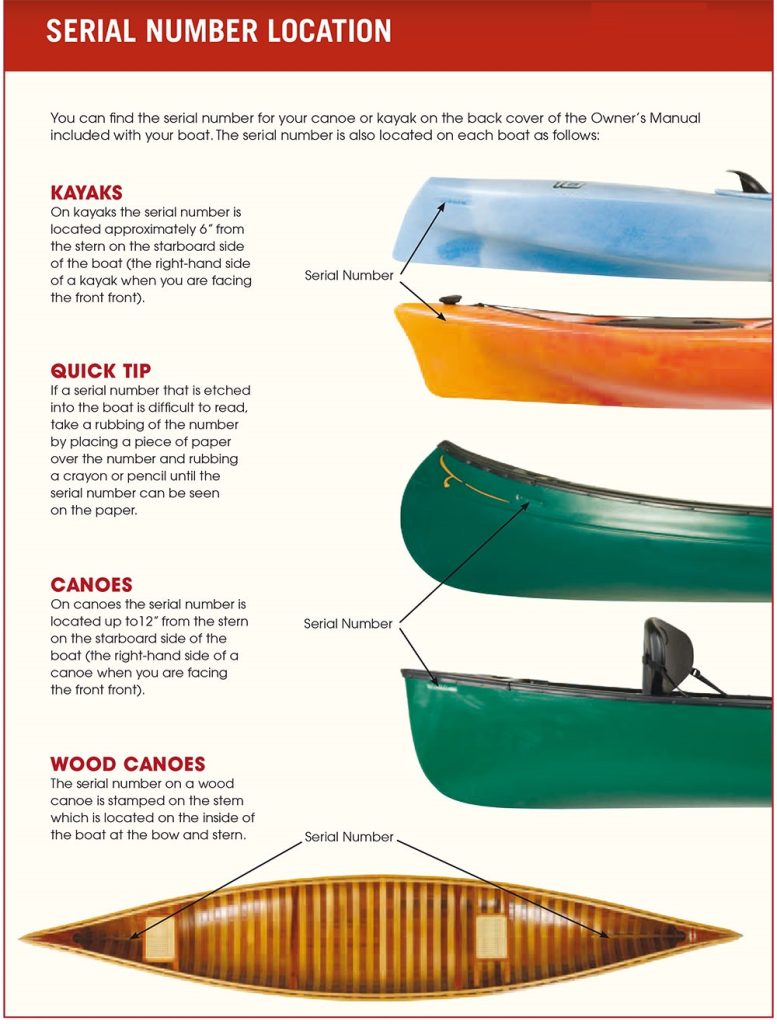
You can find the serial number for your canoe or kayak on the back cover of the Owner’s Manual included with your boat. The serial number is also located on each boat as follows.
- On kayaks the serial number is located approximately 6″ from the stern on the starboard side of the boat (the right-hand side of a boat when you are facing the front front).
- On canoes the serial number is located up to 12″ from the stern on the starboard side of the boat. The serial number on a wood canoe is stamped on the stem which is located on the inside of the boat at the bow and stern.
If a serial number that is etched into the boat is difficult to read, take a rubbing of the number by placing a piece of paper over the number and rubbing a crayon or pencil until the serial number can be seen on the paper.
No, salt water will not damage your canoe or kayak or any of its components with brief exposure. However, if you are using your boat frequently in salt water, it should be rinsed down after every use to avoid discoloration or corrosion of components.
Kayak Questions
We only recommend the manufacturer power fin for water propulsion on your inflatable board. The power fin is an electric motor designed to fit almost all types of watercraft with a slide-in fin box, such as our iSUP boards, kayaks and canoes. It helps you extend trips and save energy when fighting against wind and current.
If your kayak does not come with foot braces or if you only have one set in your tandem kayak, then you may want a Foot Brace Kit, which can be found under accessories.
Due to potential hull damage and wear points that can be caused to scuppers during use, Ocean Bay Boats does not recommend the use of kayak scupper carts. Must manufacturers recommends the use of cradle-style and other strap-style kayak carts.
No – the foam in the materials used to make the kayak throws off the transducer. so it will give a false reading. We recommend using a transducer that suctions to the bottom of the kayak.
No, the width of the kayak is more directly related to stability than its length. In general, a wider craft is a bit slower but more stable, and the better choice for fisherman and photographers. For those looking to go long distances with efficiency and speed, a longer kayak is preferred. For more information view our kayak buying guide.
You can inflate your kayak/boat by using the hand pump that comes with your package or electric pumps.
Inflate your kayak/boat by connecting the pump hose to the valve. For more inflation instructions, refer to the user manual. If you have lost your user manual, click here for an e-version.
The recommended pressure for each chamber of the kayak is illustrated in the user manual, and is also marked on the valve rubber patch. Any higher you risk over inflating and damage. Depending on the size of your kayak it can take anywhere from 5 to 8 minutes.
Follow the instructions on your user manual. If you have lost your user manual, click here for an e-version.
Whilst paddling, please consider appropriate clothing for the weather or climate. It is highly recommended to wear a buoyancy aid vest or other personal flotation device, and a wetsuit in cooler conditions. Make sure to protect yourself from the sunlight, especially when paddling close to the coast, or you may easily get sunburn.
If you’re a beginner, we strongly recommend wearing a floatation device at all times!
There are so many great places to explore with your kayak. But for the first time, we suggest you choose a calm location that is protected from both wind and waves, and choose a smooth entry point to the water to launch your kayak, like a sandy beach, grassy field or a boat dock. Always check information about local regulations and dangers related to kayaking.
Shipping Questions
For shipping of kayaks, we provide you with the option to switch your shipping to expedited LTL via TWA Freights for $450. While we cannot guarantee this option to be damage-free, you will receive your kayak in 2-5 business days. We will wrap your kayak in extra cardboard, put extra “fragile” and “no forklift” stickers on it, and do everything in our power to make sure it arrives safely.
If you select the FedEx option, then you will be required to fully inspect your kayak PRIOR to signing the delivery report. Major damage to the hull, such as a structural crack or hole, will qualify for a replacement as long as the kayak is REFUSED by the consignee. In this case, reach out to info@oceanbayboats.com and we will begin the claim process. You will be shipped a new kayak as soon as possible, depending on availability.
Another option we offer, which can be the quickest, is to pick up your kayak at either our warehouse in Miami, FL. (Native, Bonafide, Hobie, Jackson, Feelfree, and NuCanoe Kayaks can only be picked up by appointment)
All kayaks are stored at our warehouse in Miami, FL which means once your kayak is in stock, you can schedule a time to pick up your kayak at our warehouse during our business hours Mon- Fri 8 am-4 pm CST.
If you are closer to our Camdenton store and would like to pick up your kayak there, we can schedule to have your kayak taken to the store. Please allow up to 2 weeks for your kayak to be available at the storefront. Miami, FL warehouse open hours are Tues-Friday 9 am-6 pm CST & Sat 9am-2pm CST.
At this time, we are unable to ship to P.O. Boxes, due to the size of our products, as well as APO addresses. We apologize for the inconvenience.
We are proud to ship kayaks to the great state of Alaska as well as Hawaii! For Alaska and Hawaii kayaks, there is an additional $650 charge to get it to your nearest port city, where you will pick up your kayak. We haven’t come across a delivery company that will deliver kayaks in Alaska or Hawaii to your door, but if you find one, please let us know we’d love to offer that service for you as well.
Current port cities we ship to are:
- Anchorage, AK
- Fairbanks, AK
- Honolulu, HI
- Hilo, HI
- Kona, HI
- Lihue, HI
- Wailuku, HI
To be updated with the current status of your order, please email our customer service team at info@oceanbayboats.com with your order number and they will be able to assist you with any updates. Additionally, you can reach out to our chat support for any questions regarding your order.
Once an order has been placed, you cannot change or cancel your order online. To request a change or cancellation of an order, please contact us at: info@oceanbayboats.com
First, locate the product you would like to purchase and choose the quantity in the selection box. Next, click on the “Add to Cart” button. All of your products will be added to your cart.
You will find your cart at the “My Cart” button located at the upper right-hand side of the website. When you are prepared to complete your purchase, ensure your cart is correct and press “Checkout”.
Enter your shipping/billing and credit card information and follow the instructions on the checkout page. Once your order has been placed, you will receive a confirmation email from us with the details of your order.
If you would like to place an order by phone, give us a call at info@oceanbayboats.com
We have secured a new partnership with a white glove delivery service that will ensure ZERO Damaged Kayaks, better customer service, as well as quicker shipping (7-12 business days. Delivery time may vary based on location). You will no longer be required to sign and inspect your kayak. But do not worry, this carrier has a 99.97% damage-free rate and they have assured us of this.
In the rare occasion damage has been detected, Eco Fishing Shop will take care of the replacement as long as the damage is reported within 2 hours of delivery and pictures of the damage are submitted via email.
If the damage is cosmetic and/or able to be repaired, such as dents or scratches, EFS will provide a repair kit. If you choose to replace a kayak with minor cosmetic damage instead, then you will be charged a 20% restocking fee and be responsible for the return shipping costs.
The Eco Fishing Shop definition of damage is when the kayak is delivered in a condition that compromises the hull and is confirmed with the vendor that would void the warranty.
For Wilderness Systems and Perception Kayaks
Some boats from both Wilderness Systems and Perception may be shipped directly from the vendor. Kayaks shipped directly from the vendor should be received within in 3-5 business days and still have a 98% damage-free rate. They will wrap your kayak in extra cardboard, put extra “fragile” and “no forklift” stickers on it, and do everything in our power to make sure it arrives safely. You will be required to fully inspect your kayak PRIOR to signing the delivery report. If there is major damage to the hull, you will need to immediately reach out to Confluence either by submitting a form online email: info@oceanbayboats.com
Please read your email closely to see if your kayak will be shipped from our warehouse or from the Vendor directly.
If you would like to cancel an order, please email or call our customer service team immediately to avoid return shipping fees.
- For in-stock kayak orders, cancellations must be made within 24 hours. Due to our shipping and protective wrapping processes, in-stock kayaks that are cancelled after 24 hours will be subject to a 10% cancellation fee.
- For kayak orders that are cancelled after the kayak has shipped, the customer will be responsible for the initial shipping cost, the cost of return shipping, and a 20% restocking fee.
All other items that are cancelled after shipping will follow our 30 Day Return Policy and will be subject to return shipping costs.
The following only applies to Pre-Ordered Products: We understand that when you Pre-Order an item there is a chance that you may find one locally sooner than your anticipated ship date. In the event that you would like to cancel your Pre-Ordered item order, we offer a completely Free First Cancellation. However, if you decide to re-order with us and cancel for the 2nd time, you will be charged a 10% cancellation fee.
Please see our Return Policy page for more information.
The status of your order will determine the estimated delivery time frame. Our products will either be available as In Stock & Ready to ship, Exclusive Pre-Order, and/or have an estimated ETA listed. Estimated shipping dates will be listed on the product page if they will not be expected to ship within 2-5 business days. Additionally, the order confirmation you receive via email will also display the expected shipping time frame.
In Stock & Ready to Ship (Non-Kayak Orders): This time frame can be expected to ship from our warehouse or from the vendor within 3-5 business days. This includes BlueSky Boatworks.
In Stock & Ready to Ship (Kayak Orders Only): In Stock & Ready to Ship Kayaks can expect to ship on the Wednesday or Friday following your order date. We typically have truckload pickups weekly (or every other week during non-shipment weeks). When your order is placed, truck capacity may be full and your order will need to ship the following week. Please reach out to a live rep to find your exact ship date.
(We also offer Expedited Shipping for next day shipping if you want to receive your kayak in 2-5 days)
Exclusive Pre-Orders: Pre-Orders indicated that the item is currently not in stock, but an allotted amount has been secured from the Vendor with an estimated shipping time frame.
The ETA listed on the product page indicates the estimated time frame that the item will start its shipping process from our warehouse. Once the shipping process has begun, typically orders take 3 – 5 business days to arrive at the customer. (Delivery time may vary based on location)
Accepted Payment Methods:
- Credit/Debit Cards (American Express, MasterCard, Visa, and Discover)
- Bank Transfer
- Zelle
- Apple Pay
- Google Pay
An order confirmation message will be sent to the e-mail address you provide us for each order you submit. We recommend that you print and save the e-mail confirmation for your records. Please be sure to enter your e-mail address correctly to ensure that you receive your order confirmation.