Add accessories to increase storage space. | Photo: Ric Burnley
Choosing a Kayak
The biggest decision and the biggest investment is purchasing a fishing kayak. Choosing the best fishing kayak is critical to comfort, safety and success. Many anglers are tempted to buy a cheap kayak to get started. “When you are ready to step up, come and see me,” Dean Lokey, owner of OC KAYAK in Ocean City, Maryland, says. Many of Lokey’s customers bought a “starter” kayak only to step up to a better boat.
Chase Christianson, manager of Great Outdoor Provision Company in Virginia Beach, puts it this way, “Buy once, cry once.” He explains an angler is better off spending more money upfront for a quality kayak than buying a bargain boat and later upgrading. “The biggest problem is a new angler who has a bad initial experience and quits kayak fishing to take up golf.”
Christianson and Lokey encourage anglers to choose a kayak from a reputable kayak company with a pedigree of design, durability and versatility. Christianson says a good kayak uses premium materials and sturdy construction. “The plastic is heavier and the boat has a solid feel,” he explains. He looks for a quality seat, rudder system, rod holders, hatches and gear tracks. A fishing kayak is more than a plastic shell—there are dozens of features to improve function and comfort.
A quality kayak is designed and built by people who fish from a kayak. The best kayak companies use professional kayak anglers to test and develop their products. The result is a kayak that performs better with parts that will last the test of time. The same designs trickle down to the company’s less expensive models.
For anglers on a tight budget, bargain boats offer an affordable way to get on the water and into the action. For an angler interested in getting his feet wet without jumping into kayak fishing headfirst, a budget-friendly kayak will provide a taste of the experience. Lokey and Christianson say many of their customers start simple and then come to their shop to upgrade.
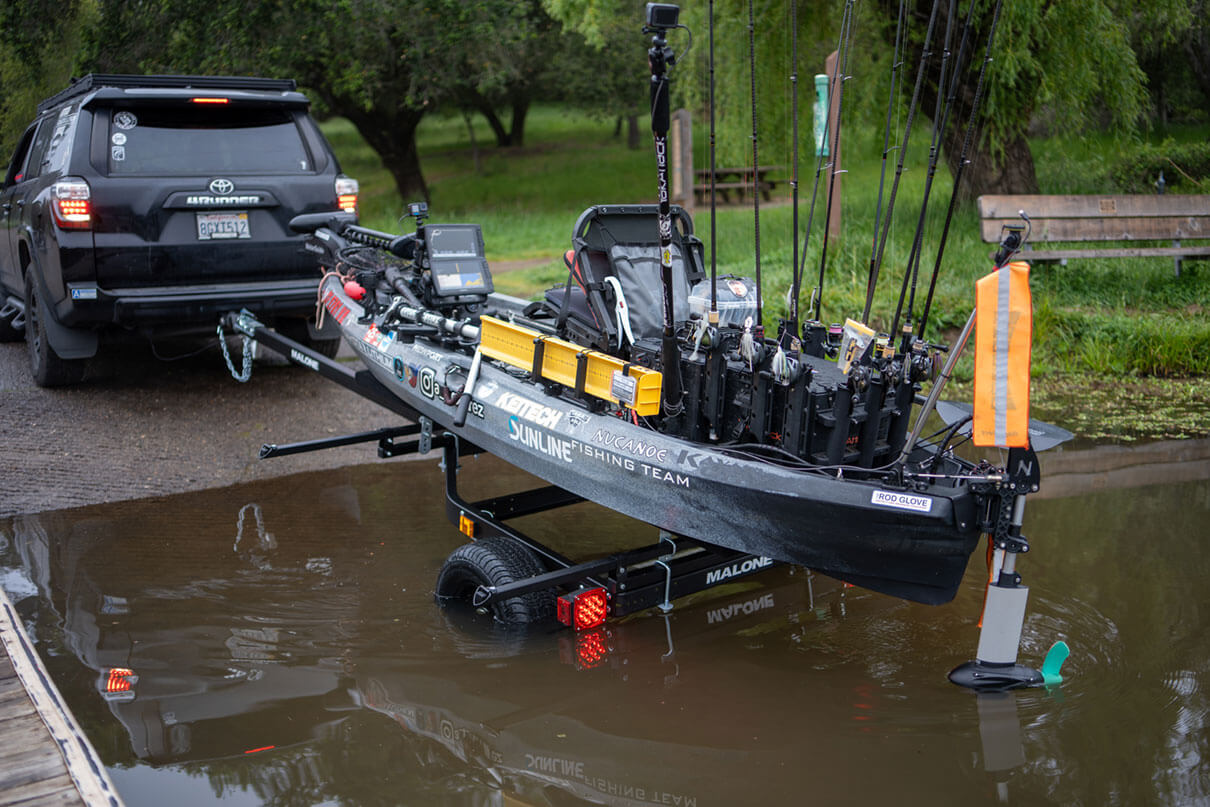
Large kayaks require a trailer. | Photo: AJ Ramirez
Transportation and Storage
The final question can be a deal-breaker: how will you transport and store the kayak? Christianson puts kayaks in three categories: car-top, truck bed and trailer. “A kayak under 80 pounds rides flat on roof racks,” he says. A kayak from 80 to just over 100 pounds can be wrestled into a truck bed. “Use a bed extender for a kayak over 10 feet long,” he recommends. Heavier, wider and bulkier kayaks, especially motorized kayaks, require a small kayak trailer. “A lightweight trailer is a great idea for cars and SUVs,” Christianson adds.
Most fishing kayaks are too big and awkward for an angler to carry without a small cart. “Be sure to match the cart cradles to the hull shape,” Christianson adds. The kayak needs to be stored on its side or standing on end to protect the plastic from warping. “Be sure there is room in the yard for the boat,” he says.
To narrow the kayak choices down to the perfect fit, filter through fishing needs, propulsion preference, transport, storage and rigging potential. Lokey says, “There are a lot of options and one boat will match the angler’s needs.”
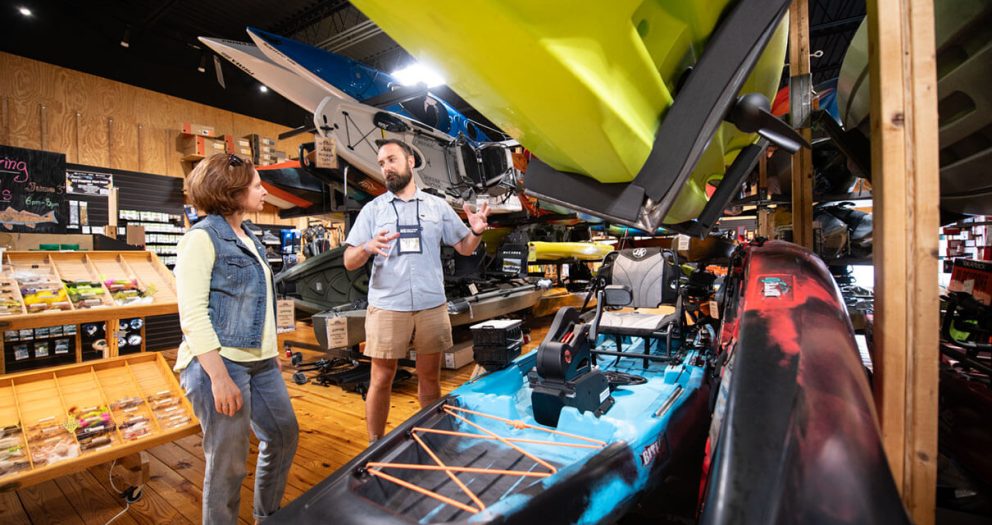
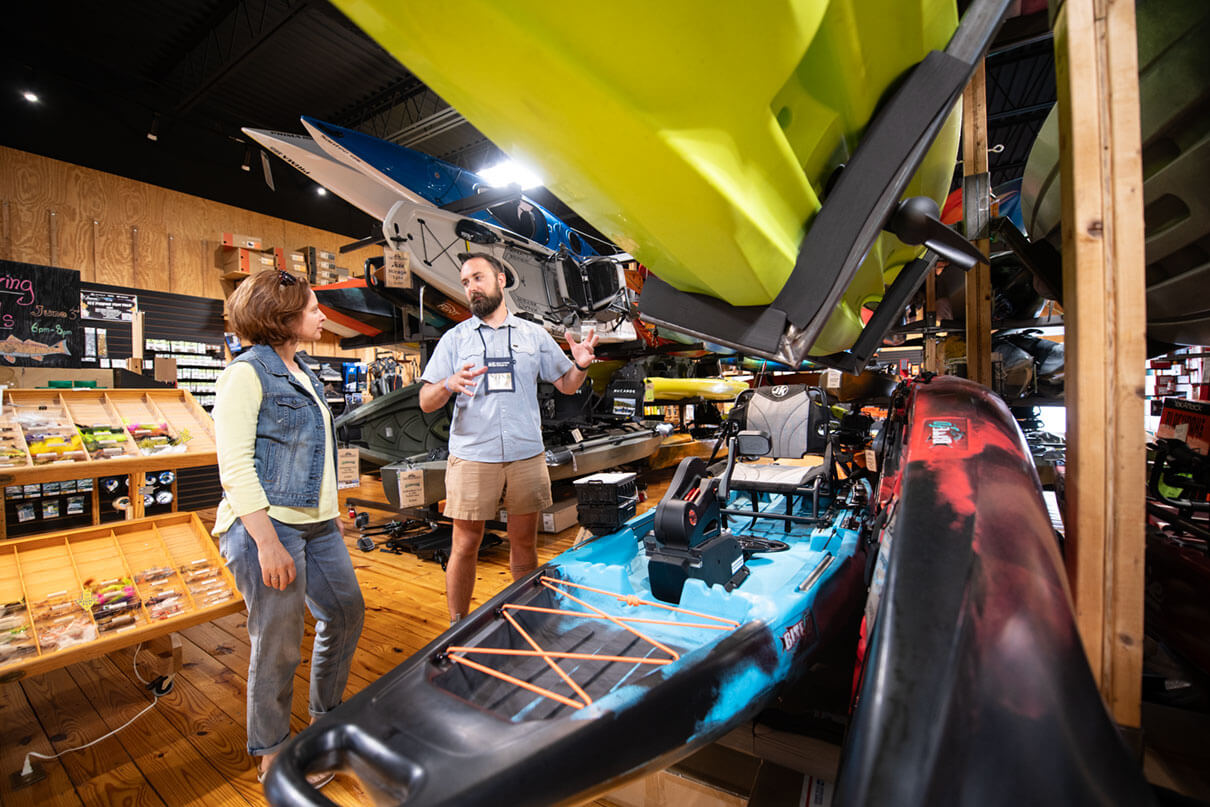
The journey begins in the kayak shop. | Feature photo: Ric Burnley
Paddle, Pedal or Motor
Once money talk is out of the way, the outfitters focus on fitting the kayak to the owner. Christianson and Lokey first ask where the customer plans to fish. Lokey explains, “If you are fishing in ponds, we go with a shorter, wider kayak for maneuverability and stability. For saltwater or large lakes, I recommend a longer, more seaworthy kayak.”
Just as the beginning kayaker has a long list of questions about the basics of kayaking, the angler looking to get more serious about fishing from a kayak also needs some guidance, whether it’s about safety, rudders, anchors, rod holders, crates, or even apparel
I can hardly believe it is already September and we are on the verge of the fall run. I hope that up to now you’ve had as great of a kayak-fishing season as I have. This season has been an interesting one for sure! I have seen an amazing increase in the number of new kayak anglers, from kids, to cash-strapped boat anglers, to shore-bound anglers tired of fighting for space on the beach. Kayak angling has definitely evolved from a small contingent of anglers into a strong segment of the angling population.
For new anglers, the jump to getting your feet wet in kayak fishing initially seems intimidating. The summer months offer a great chance to get in a kayak for the first time, on a lake or pond, and learn the basics of kayak-fishing. As anglers gain experience, they tend to become more efficient and confident on the water.
When September rolls around, many of the anglers that had their first kayak-fishing experience during the summer will be ready to take it up a notch, and experience new and exciting aspects of kayak angling that coincide well with the unique fishing opportunities that present themselves this time of year. The angler that launched a kayak for the first time on a small pond in May might be ready to take advantage of the great fall fishing for striped bass from a kayak once September rolls around.
Just as the beginning kayaker has a long list of questions about the basics of kayaking, the angler looking to get more serious about fishing from a kayak also needs some guidance, whether it’s about safety, rudders, anchors, rod holders, crates, or even apparel, and those are the questions I would like to use this column to address.
First I’ll share a bit about my overall approach to kayak angling. I am very careful and like to spend a good amount of time planning each trip out. Despite the thought I put into my preparation for each trip, I still do my very best to keep things as simple as possible. I pack and plan each outing based on one very simple rule: my gear and my game plan must always improve my odds of an optimal angling presentation, but without compromising safety.
With that in mind, here are some common questions I see from kayakers looking to take that next step, and the best answers that I can give.
Rudders
Good boats do not need a rudder. Having that said, there are two good reasons to use a rudder. First, not all kayaks are sleek, aerodynamic ocean-going vessels. Many are larger boats with bigger beams and more freeboard so they turn slowly and have a tendency to catch more wind. A rudder makes these boats navigate better and allows the angler to position them more effectively. Secondly, wind is the great equalizer. No matter what exotic fishing kayak you might own, the wind is a constant factor. It can blow you out of optimal fishing presentations. In addition, paddling in a strong quartering wind for any distance without a rudder requires very good technique and a lot of strength. As a beginning paddler, one cannot be expected to do that effectively or safely right away.
Anchors and Stakeout Poles
Being able to remain stationary in an optimal area will most often maximize your chance at fishing success, but a word should be said here about safety. I don’t like the combination of ropes, kayaks and current. Not one bit. I know plenty of anglers who do it and do it safely. They use quick-release float systems and have found ways to minimize the amount of loose rope around the deck. They approach its use with caution and respect. You can become separated from your boat quickly in a current, and you can also flip your boat really easily while using an anchor. Therefore, I don’t think an anchor system makes my must-have list.
Apparel
Drywear is a major part of kayak fishing in the Northeast. An entire article could be written just about the correct kayaking clothing. Hypothermia is a real threat for a significant portion of our season. There are many ways to ensure that you’ll likely stay warm and dry while kayaking. Drysuits are perfect, but they are expensive. Waterproof socks and paddle pants are O.K., and work well to resist a splash of water, but are ultimately not enough if you flip your kayak in very cold water and can’t recover immediately. You will get wet after a moment, and even if you quickly self-rescue if you are any distance from a warm, dry place, you might be in big trouble. Waders seemingly solve this problem, but only to the waist. There are many expert kayak anglers that advocate their use. I am in the camp that does not.
Waders have a simple flaw that no amount of clever discourse can change. There is no true watertight seal. Period. If you go in, you will eventually get wet. If you are separated from your boat you are again in an uncomfortable, and perhaps deadly, place. If you are conflicted, my advice would be to contact the U.S. Coast Guard. They should have the final word. Let me know what they tell you. My drysuit is as comfortable as pajamas and the peace of mind is priceless.
Rod Holders
The battle for the best kayak rod holder often comes down to two companies: Scotty and Ram rod holders. The winner? They both win. I have many products from both companies. The Scotty is plastic and uses a ratcheting system. They are very versatile and have many products to suit almost any fishing application. The Ram uses a metal ball mount system and features a lower profile. The ball mount offers 100 percent articulation of your rod holder. I keep mine 85 percent tightened and when I get a hit the holder swings back and right into my hands, which means no reaching.
Which rod holder you choose will also depend on your boat. Some boats do not have the space for Scotty mounts, while others are seemingly molded to accept them. The choice is yours. You should consider simplicity in your decision. I don’t advise decorating your boat with a picket fence of rod holders. Start with one, maybe two. Try one in front and one in the back. Please make sure to paddle your boat before you mount them. Placing a mount even a few inches to far forward or astern can place your rod uncomfortably, and even dangerously, out of reach. Also, in keeping with my rule about safety, you should notice that trying to turn a boat back over and self-rescue with a picket fence of rod holders would be very difficult at best.
Crates
You can make them, mold them and even buy some really sweet crates, and depending on your personal preference, they make perfect sense. You can effectively pack a ton of stuff in a crate. My advice is not to pack them too full. Its tough to get everything back in when you’re on the water. They are a great way to make sure your gear is contained and safe. They do, however, catch a good bit of wind. They will affect your positioning in wind. I also find them awkward to get gear in and out of. I often use dry bags tethered to the well area, which I just pull up and put in my lap to get my gear. I also devised a trolley system under my center hatch to hold a lot of terminal gear and stuff I want quickly in hand without having to twist around.
Use September to practice and get familiar with your gear. If you are an accomplished kayak angler, it’s a great time to plan your strategy for when the fish start getting feisty as the water cools. When September rolls into October, you will get your chance for a shot at the awesome fall migration of stripers and blues. You’ll also have a shot at one of the most fun fish to catch in a kayak, the false albacore!
The 12-foot 120 PRO ditches the drive system but keeps the accessory tracks, motor mounts, and stand-up stability that made the PDL version a favorite among kayak anglers.
I’ve spent a lot of hours fishing from the Old Town Sportsman PDL 120 PRO, and one thing has always stood out: the deck space and storage on that platform are abundant, even with a pedal drive taking up real estate in the hull. So when Old Town dropped the Sportsman 120 PRO — the paddle-only version of that same platform — I immediately started picturing what that cockpit feels like with the drive well gone entirely. My guess: it’s going to feel a lot like standing on the deck of a flats skiff or bass boat.